

On Sept. 21, 1994, the Little Traverse Bay Bands of Odawa Indians (LTBB) was federally reaffirmed with the signing of Public Law 103-324. The Tribe is governed by a nine member Tribal Council who serve staggered terms. The Tribe has over 4,000 members with a large number living within Charlevoix and Emmet Counties. The Little Traverse Bay Bands of Odawa Indians presently employs over 100 full and part-time employees. The historically delineated reservation area, located in the north-western part of Michigan’s Lower Peninsula, encompasses approximately 336 square miles of land within the two counties. The largest communities within the reservation boundaries are Petoskey, Harbor Springs, and Charlevoix.
LTBB Mission Statement
Being Odawa is all about freedom. The Freedom to be a part of a people who, with integrity and pride, still have and speak our own language. The freedom to share in common with all other Odawak the customs, culture, and spirituality of our ancestors. The freedom we have today we will bring to the future through unity, education, justice, communication, and planning. We will reach out to the next seven generations by holding to cultural values of Wisdom, Love, Respect, Bravery, Honesty, Humility and Truth. We will utilize our Tribal assets to provide the necessary tools to become successful, hard-working community members who proudly represent our culture. With these values we will move the Tribe forward.
Anishinaabemowin Interpretation of LTBB Mission Statement
Debendiziwin aawan maanda Odawa aawiyiing. Geyaabi gdaa’aanaa miinwaa gdanwewmi Anishinaabemowin, maanda egishkaago’iing debendiziwin ebidgwasiing mnaadendiziwin miinwaa wiimnaadendiziyiing. Gdabendaanaa debendiziwin kina gwaya Odawak naasaap eyaamjik, maanda naakinigewinan, maadiziwin miinwaa mnidoowaadiziwin gaanaaniigaaniijik debendamowaad. Maanda debendiziwin eyaamiing nangwa, kanamaajiidonaa niigaan ezhibezhigoyiing, kinoomaadwin, dbaakinigewin, giigidowin miinwaa naakinigewin. Kazhiibiignaketaanaa maanda niizhwaachiing bimaadiziwin waabii’aamigak mjignamiing ninda mnomaadiziwinan echipiitendaakin: nbwaakaawin, zaagidwin, mnaadendamowin, aakde’ewin, gwekwaadiziwin, dbaadendiziwin miinwaa debwewin. Kanakaazinaa ninda gdabendaaswinaanin, jimiigwe’iing nakaazwinan jimnomewzi’iing, enitaanokiijik maampii Anishinaabek enaapshkaamwaad maanda gbimaadziwinaa. Ninda eyaamiing echipiitendaakin, mii go kina gwaya maampii enjibaad jiniigaanibizad.
Spoken Mission Statement Audio
Normal Speed
Slower Speed
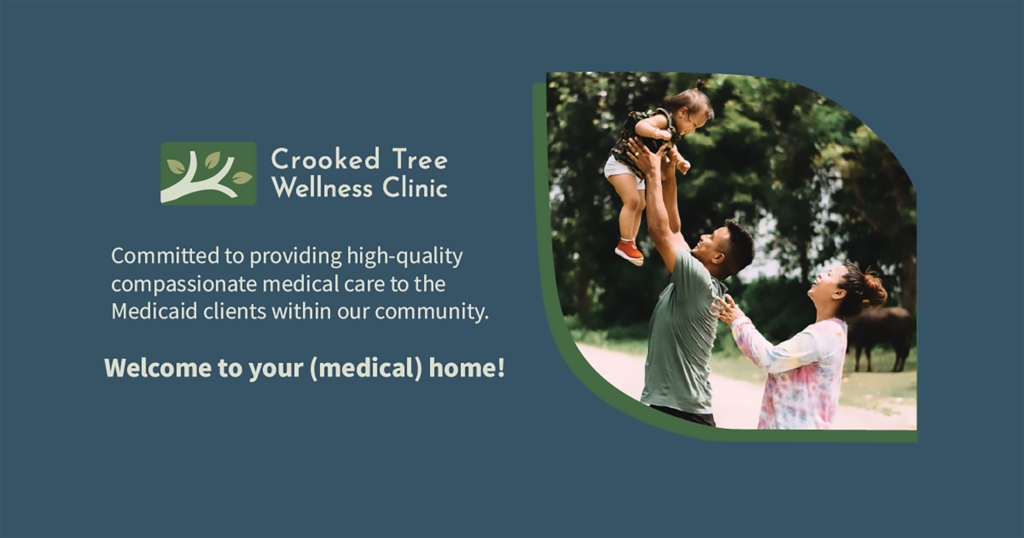
Crooked Tree Wellness Clinic
(231) 242-1760
Website: https://ctwc.health
Crooked Tree Wellness Clinic is open and accepting patients! Anyone who has Medicaid as primary insurance is eligible to be seen at CTWC!
Appointments available for Native and non-Native people.
Tribal Citizens, if you have family members or friends who are on Medicaid and in need of medical services, please tell them about Crooked Tree Wellness Center.
Crooked Tree Wellness Center has appointments available Monday – Thursday, 7:20 am – 4:30 pm.
Phone number is: 231-242-1760.
Upcoming Meetings & Events
Join Zoom Meeting
https://us02web.zoom.us/j/89029815737?pwd=MkFPZVlabERlOEVTbU1QeDA4ckhnUT09
Meeting ID: 890 2981 5737
Passcode: 910932
—
One tap mobile
+13052241968,,89029815737#,,,,*910932# US
+13092053325,,89029815737#,,,,*910932# US
—
Dial by your location
- +1 305 224 1968 US
- +1 309 205 3325 US
- +1 312 626 6799 US (Chicago)
- +1 646 931 3860 US
- +1 929 436 2866 US (New York)
- +1 301 715 8592 US (Washington DC)
- +1 564 217 2000 US
- +1 669 444 9171 US
- +1 669 900 6833 US (San Jose)
- +1 689 278 1000 US
- +1 719 359 4580 US
- +1 253 205 0468 US
- +1 253 215 8782 US (Tacoma)
- +1 346 248 7799 US (Houston)
- +1 360 209 5623 US
- +1 386 347 5053 US
- +1 507 473 4847 US
Meeting ID: 890 2981 5737
Passcode: 910932
Find your local number: https://us02web.zoom.us/u/keDqGCGrx
TC – Motion to adopt Tribal Resolution# XXXXXX-XX Appropriation of Funds for the 2025 Fiscal Year Operating Budgets.
Join Zoom Meeting
https://us02web.zoom.us/j/85453539562?pwd=Qk1zeXpSdDZQek9oMEhqdk1GUythdz09
Meeting ID: 854 5353 9562
Passcode: 642133
—
One tap mobile
+13092053325,,85453539562#,,,,*642133# US
+13126266799,,85453539562#,,,,*642133# US (Chicago)
—
Dial by your location
- +1 309 205 3325 US
- +1 312 626 6799 US (Chicago)
- +1 646 931 3860 US
- +1 929 436 2866 US (New York)
- +1 301 715 8592 US (Washington DC)
- +1 305 224 1968 US
- +1 507 473 4847 US
- +1 564 217 2000 US
- +1 669 444 9171 US
- +1 669 900 6833 US (San Jose)
- +1 689 278 1000 US
- +1 719 359 4580 US
- +1 253 205 0468 US
- +1 253 215 8782 US (Tacoma)
- +1 346 248 7799 US (Houston)
- +1 360 209 5623 US
- +1 386 347 5053 US
Meeting ID: 854 5353 9562
Passcode: 642133
Find your local number: https://us02web.zoom.us/u/keIM5LYzb9
Important Information
Latest News
12/21/2023
The Archie Kiogima Jr. ba Migizi (Eagle) Aviary and Rehabilitation Center Press Release
MICHIGAN ODAWA NATIVE AMERICAN TRIBE AND WINGS OF WONDER PARTNER ON EAGLE AVIARY AND RAPTOR CENTER
Little Traverse Bay Bands and Celebrated Michigan Raptor Rehabilitator Collaborate on First Tribal Eagle Aviary and Raptor Center East of the Mississippi River
The Archie Kiogima Jr. ba Migizi (Eagle) Aviary and Rehabilitation Center will enable tribe to save federally protected eagles and educate public on their importance to Native American culture
MICHIGAN (December 20, 2023) — Little Traverse Bay Bands of Odawa Indians (LTBB) is proud to announce the award of a $250,000 matching grant from the Shakopee Mdewakanton Sioux Community as a part of its continued campaign to fund and build the Archie Kiogima Jr. ba Migizi Aviary and Rehabilitation Center. LTBB is seeking like-minded Tribes, groups and individuals in the care and protection of injured Eagles and other raptors through the construction of top-notch facility on Tribal land nestled within a Northern Michigan.
LTBB has had a long-term relationship with one of the country’s most celebrated raptor rehabilitators, Rebecca Lessard founder and operator of Wings of Wonder (WOW) located in Empire, Michigan. During that time, the LTBB Natural Resource Department rescued and transported dozens of eagles and other injured birds of prey to WOW for treatment. Many of these raptors were able to return to tribal lands for release back into the wild. However, after rehabilitating hundreds of eagles and other raptors for over 30 years Rebecca Lessard is now retired. Please help the LTBB Natural Resource Department (NRD) cement Wings of Wonder (WOW) and former longtime WOW icon Rebecca Lessard’s legacy through donation funds necessary for the construction of the Archie Kiogima ba Migizi Aviary and Rehabilitation Center. Total project costs are estimated at $2.3 million. The funding campaign is on the way to that funding goal however a significant amount of funding is needed yet. A minimum of $250,000 in additional donations are needed in order to fully realize the Shakopee Mdewakanton Sioux Community grant as such LTBB has recently created an informational webpage (https://ltbbodawa-nsn.gov/migizi-aviary/) on the project with online donation capabilities.
The Bald Eagle, “Migizi” is a highly respected and significant cultural species to many Native American Tribes, including the Little Traverse Bay Bands of Odawa Indians. Preserving this highly revered and significant cultural species for the next seven generations is a high priority for the LTBB.
12/01/2023
Living Wage Memo Effective 01/01/2024
Per Tribal Resolution #102619-05 Promotion of a Living Wage, the calculations for the Living Wage are as follows:
Living Wage Memo effective 010124
03/19/2024
Housing Developments Presentation
12/12/2023
Free Tax Assistance at LTBB
As we are approaching tax season, I wanted to share an exciting announcement from the LTBB Department of Commerce. Please see below and attached, and share with those who may be interested. We are excited to bring this service here to LTBB!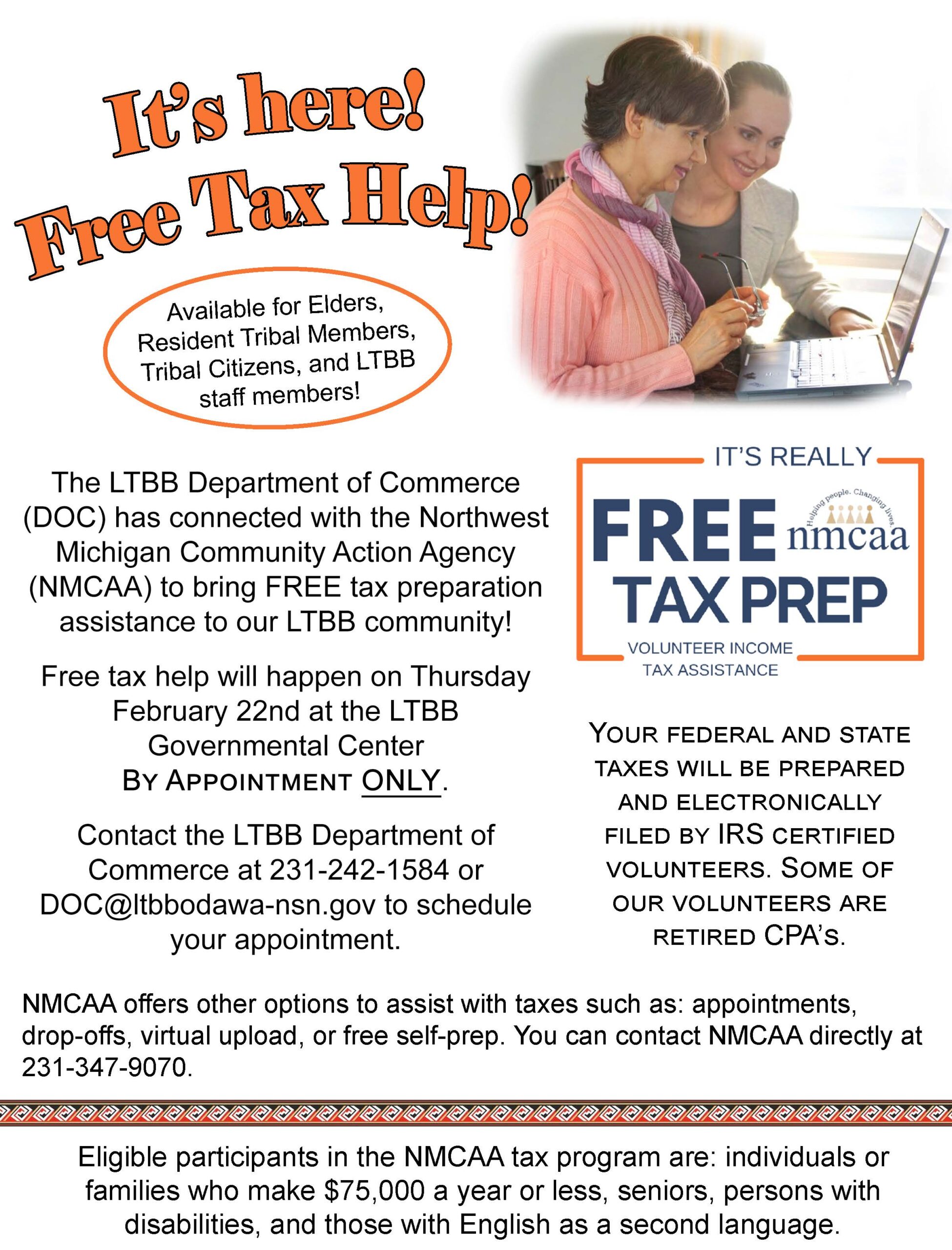
The LTBB Department of Commerce (DOC) has connected with the Northwest Michigan Community Action Agency (NMCAA) to bring FREE tax preparation assistance to LTBB! We will coordinate with their team of IRS-certified Volunteer Income Tax Assistances (VITA) to bring a 1-day service to the LTBB Government Center where we will schedule appointments to have income taxes done for FREE! We are anticipating one day in February 2024 occurring on a Tuesday, Wednesday, or Thursday to reach our Elders lunch attendees, but additional days may be added depending on level of interest. This service will be provided on a scheduled appointment-basis, rather than walk-in service.
Because our Elders + Resident Tribal Members can be uniquely impacted by tax preparation season, these groups will be prioritized when scheduling appointments. Then it will be opened up to all eligible LTBB Tribal Citizens, and if we continue to have the resources, it will open up to non-Citizen LTBB staff members. While we will originally plan for one day, additional days may be added depending on interest level.
Please let DOC know if you are interested in this free tax service so we can coordinate with NMCAA on scheduling. While this won’t commit you to making an appointment at this time, it will be helpful for us to gauge the level of interest. Comments, messages, emails, or phone calls will be accepted to express an interest! DOC can be reached at 231-242-1584/231-420-2924 or DOC@ltbbodawa-nsn.gov. Once a date is scheduled, we will post another announcement letting Citizens know that appointment-scheduling is opened up.
For some background information on the VITA program: this is an IRS program that offers free basic tax return preparation to qualified individuals. VITA operates through partner sites such as the NMCAA. The VITA program has operated for over 50 years. More information can be found on the IRS website at: https://www.irs.gov/individuals/free-tax-return-preparation-for-qualifying-taxpayers.
For those not interested in participating in an LTBB-scheduled tax day, NMCAA does have other client-directed options to assist with taxes such as: appointments, drop-offs, virtual upload, or free self-prep. You can contact NMCAA directly at 231-347-9070 or visit their website at https://www.nmcaa.net/tax_preparation.asp. We will post additional announcements closer to tax time with their contact information again. Office locations include: Petoskey, Traverse City, Cadillac, Charlevoix, Honor, Benzonia, and Kalkaska. DOC is happy to help get you connected with an NMCAA office. For those not located in these areas, there may still be VITA services near you! VITA programs are available in many other areas, including outside of Michigan. Here is a link where you can search for a VITA provider in your area: https://irs.treasury.gov/freetaxprep/.
*Eligible participants in the NMCAA tax program are: individuals or families who make $75,000 a year or less, seniors, persons with disabilities, and those with English as a second language.
Please contact DOC if you are interested in this service!

-
-
17Apr
-
12Apr
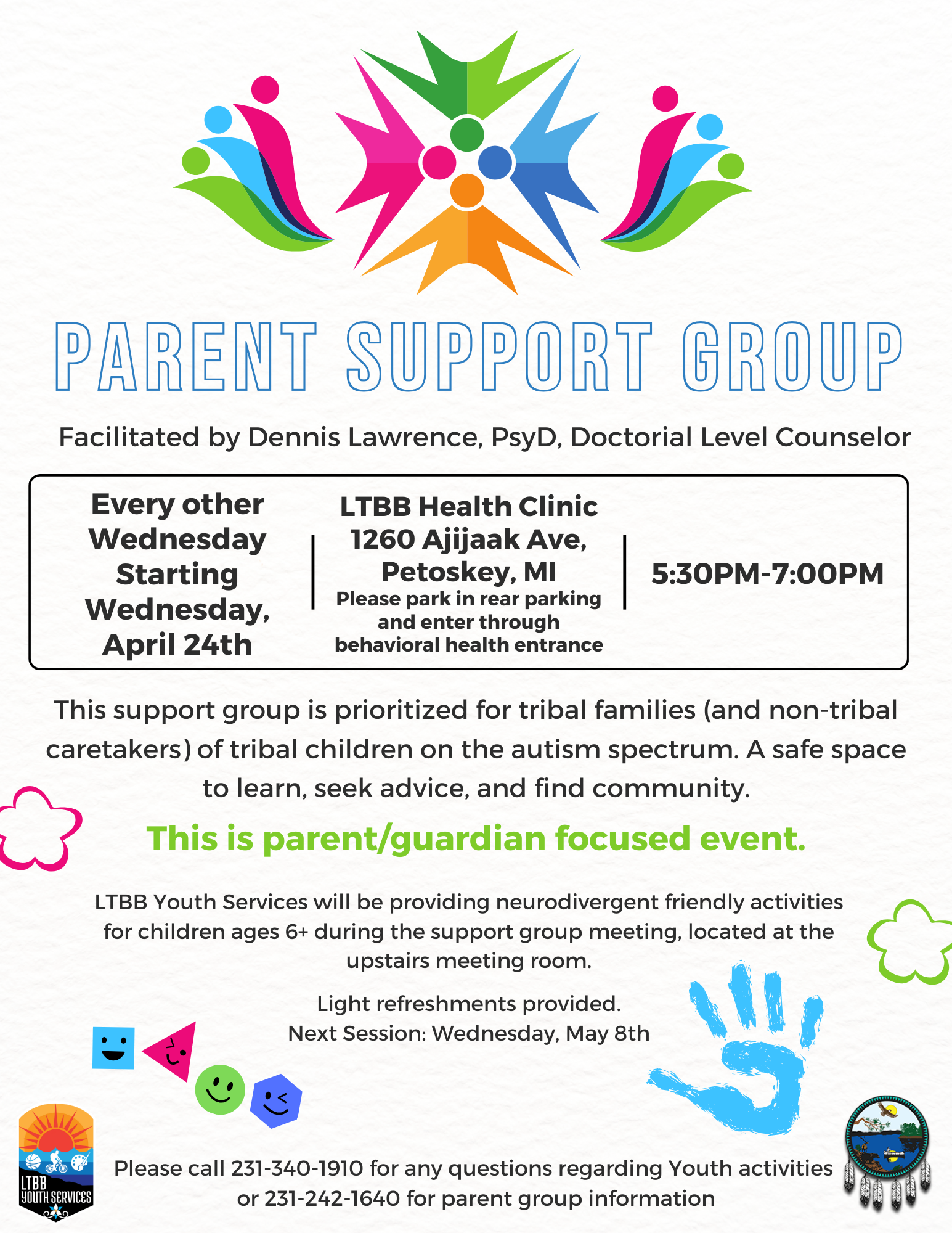
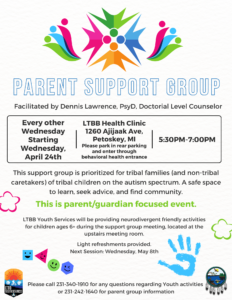
Parent Support Group
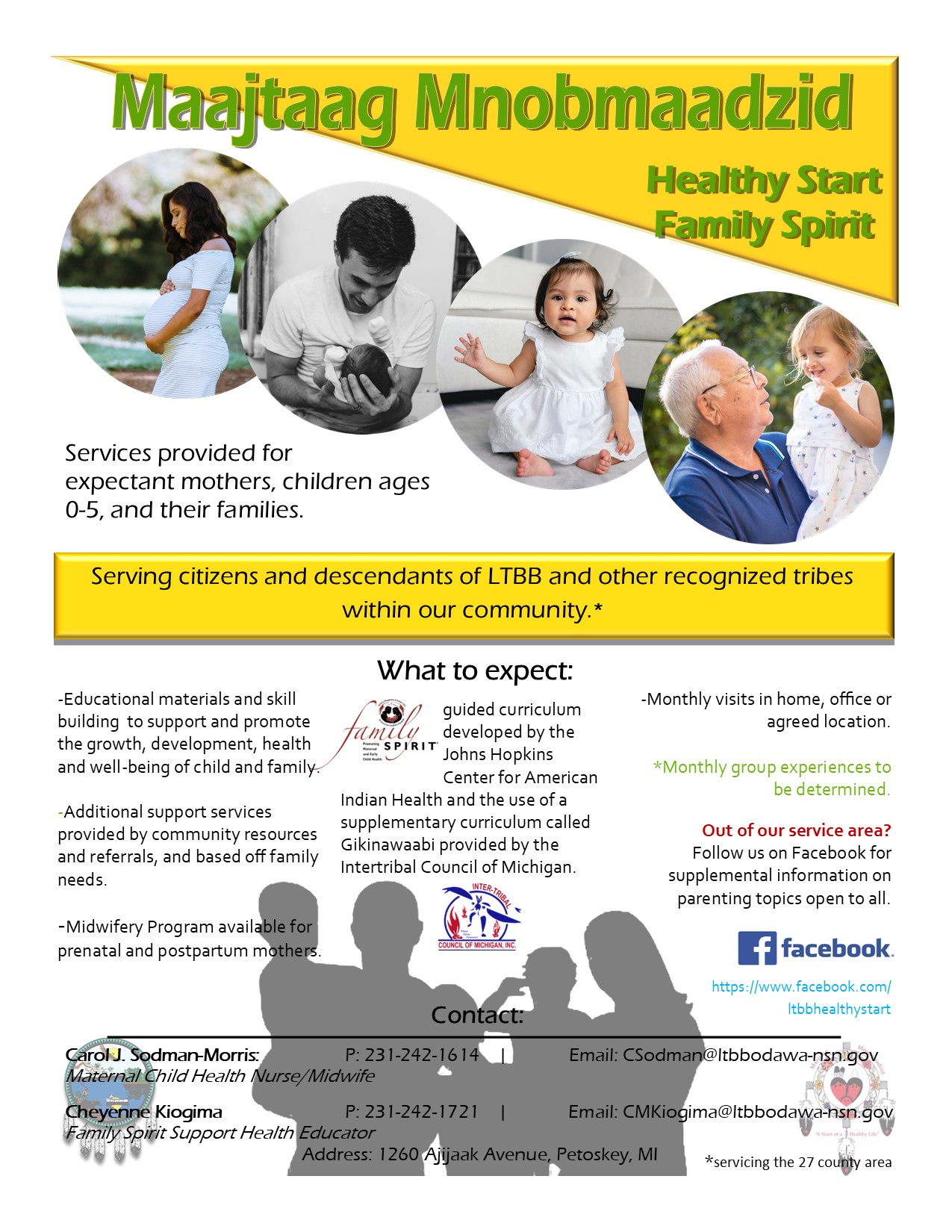
We are excited to announce the date for our new Parent Support Group in collaboration with Dr. Lawrence and LTBB Behavioral Health. We would like to invite caretakers/parents of tribal children on the autism spectrum to come join us every other Wednesday, starting April 24th from 5:30-7:00PM at the LTBB Health Clinic Behavioral Health meeting room (rear parking lot, behavioral health entrance).
(Read More)... -
19Mar
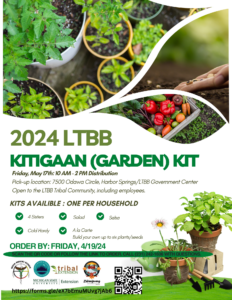
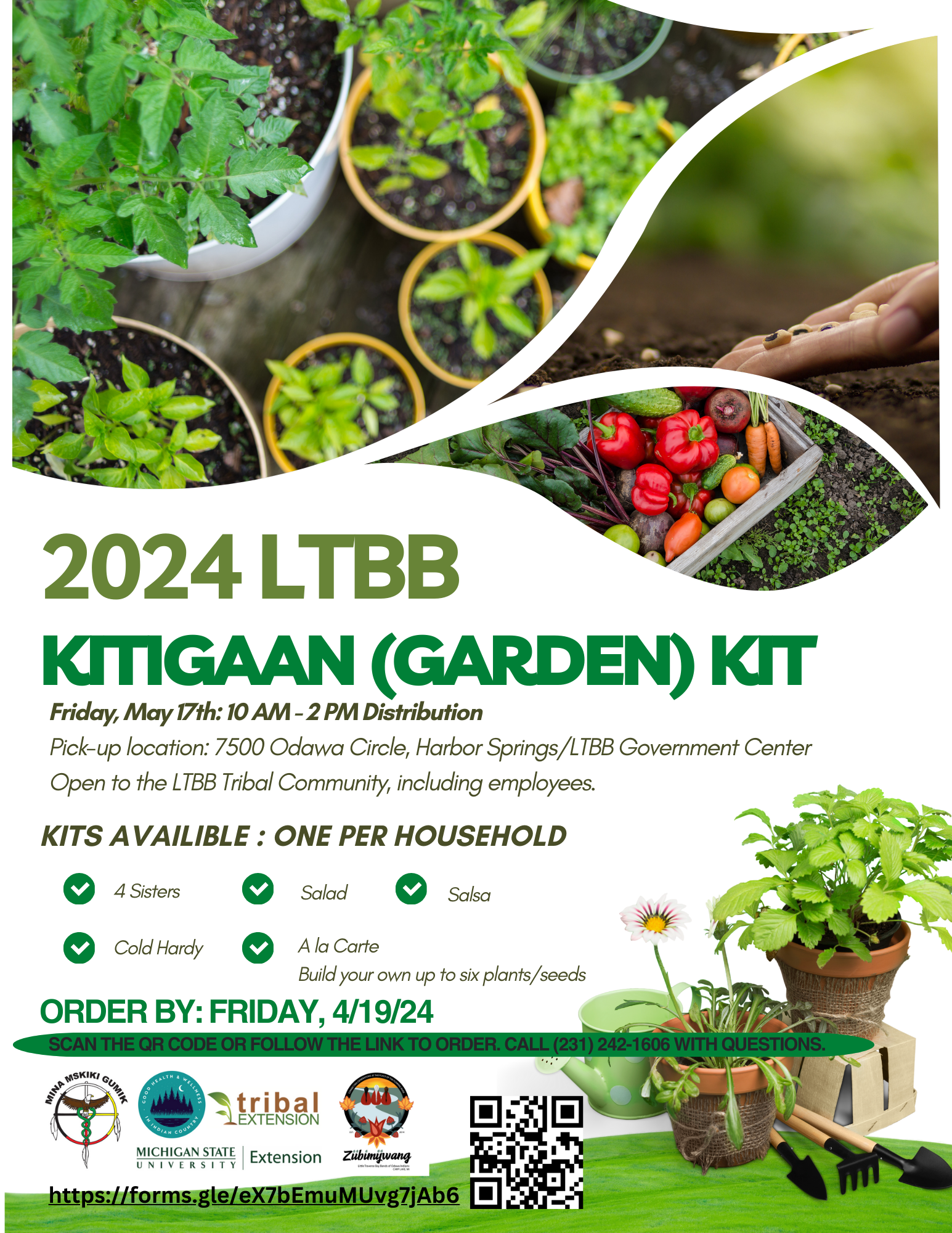
2024 Kitigaan Kit Registration Now Open
Happy Spring! It is a little hard to dream of our summer gardens on this snowy day but maybe it is just the thing we need! Registration is now open for the 2024 Kitigaan Kits. Please sign up here. We ask that you keep this to one kit per household. This is open to the LTBB Tribal Community, which includes employees.
(Read More)... -
12Mar
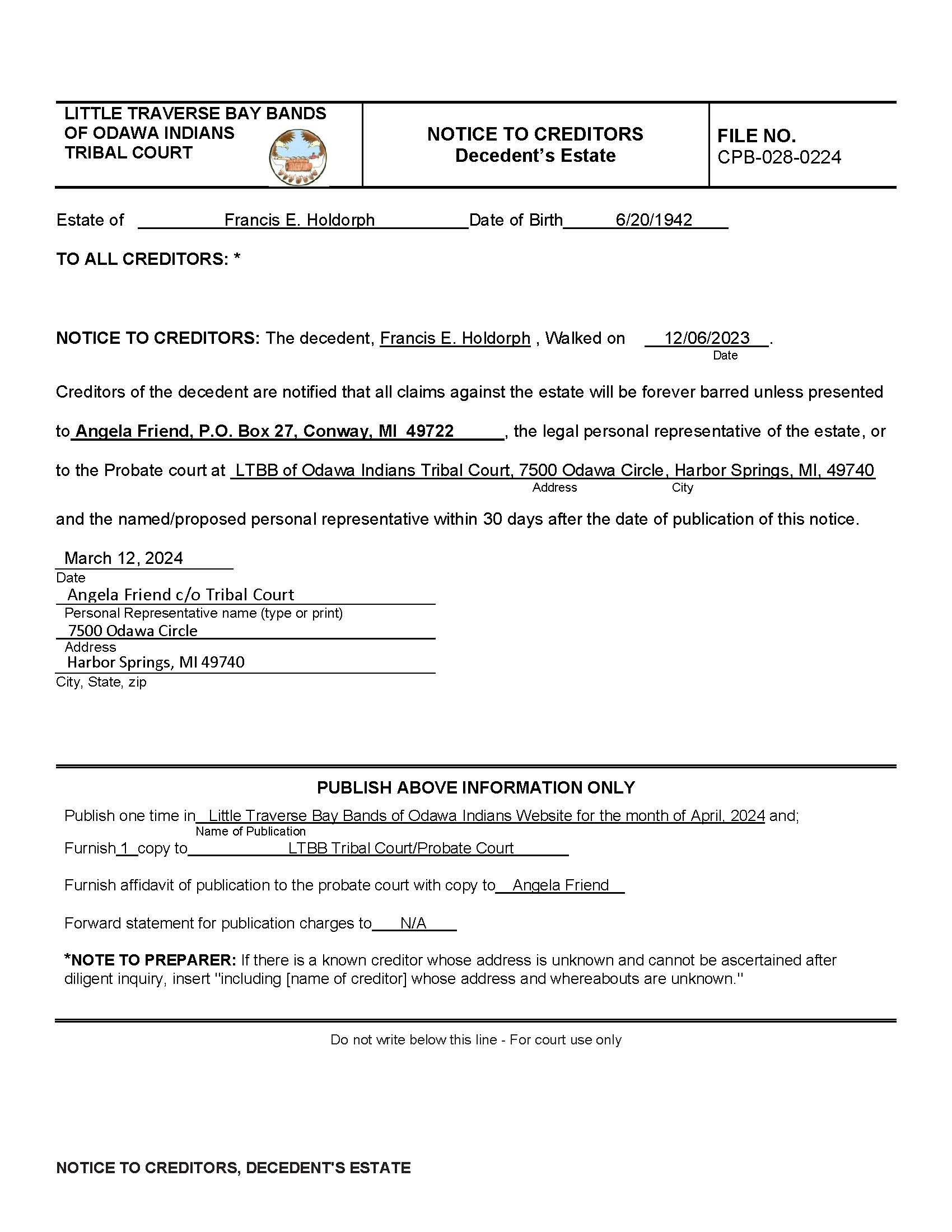
Case No. CPB-028-0224 Notice to Creditors
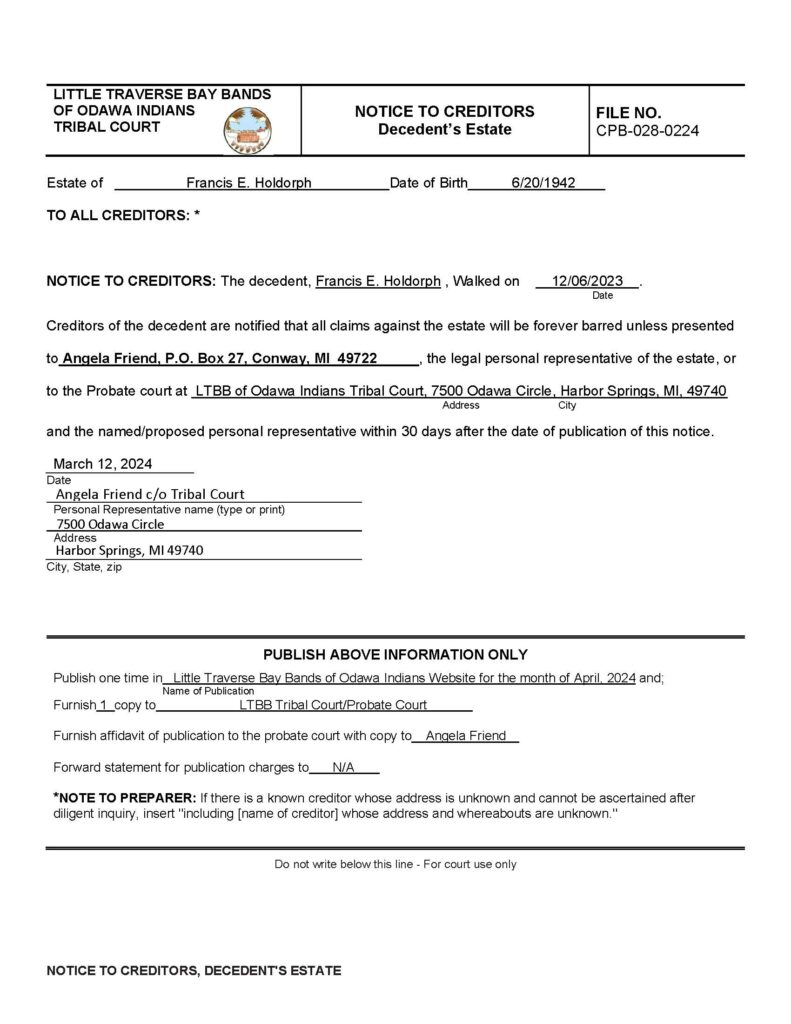
Download Document: CPB-028-0224 - Notice to Creditors
(Read More)... -
11Mar
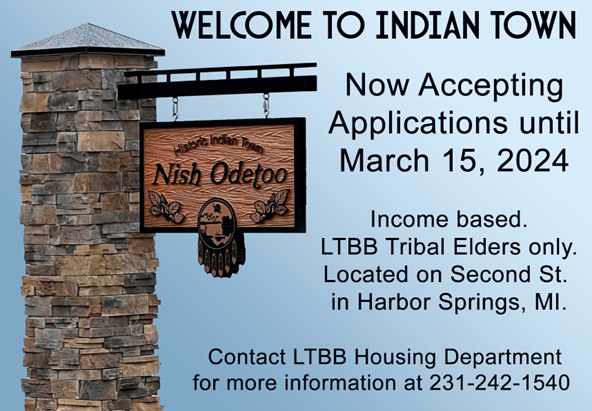
Indian Town Housing Development
As seen in the Odawa Trails March Edition, we are still accepting applications for the new Indian Town Housing Development in Harbor Springs.
Please contact our Housing Department for more information. Applications can be found on the LTBB website or at the Government Center.
(Read More)...
Flyers